
If you’re new to horses, one of the first distinctions you may notice is that not everyone rides the same way.
Two of the most recognizable approaches are Western riding and English riding.
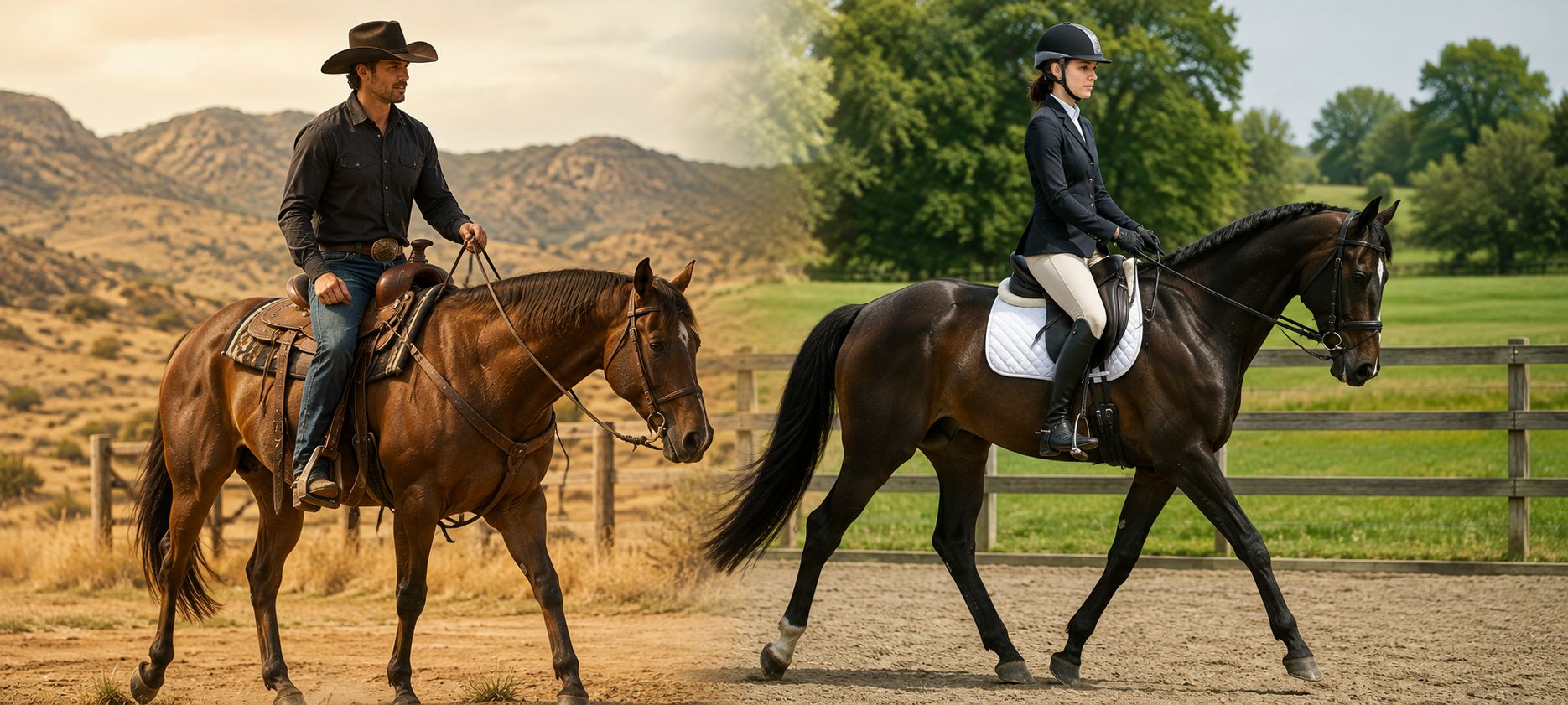
At first glance, the differences seem obvious. Western riders are often associated with large saddles, cowboy hats, ranches, and open country, while English riders are commonly associated with smaller saddles, riding breeches, jumping, and traditional equestrian competition.
But the differences go much deeper than appearance.
Western and English riding developed from different histories and practical needs. Those origins influenced everything from saddle design and riding equipment to how certain disciplines evolved.
At the same time, both styles share an essential foundation: good horsemanship, balance, communication, and respect for the horse.
Let’s look at the major differences.
What Is Western Riding?
Western riding developed largely from horseback traditions associated with ranch work and managing livestock across large areas of land.
Riders often needed to spend long periods in the saddle while performing practical tasks. As a result, Western equipment and riding traditions developed around the needs of working horseback.
Today, Western riding includes both recreational riding and a wide variety of competitive disciplines.
Depending on where you ride, you may encounter activities such as:
- Trail riding
- Western pleasure
- Reining
- Cutting
- Ranch riding
- Barrel racing
- Roping-related disciplines
Western riding has expanded far beyond ranch work, but its historical influence remains easy to see.
What Is English Riding?
English riding refers to a broad family of riding traditions and disciplines that developed differently from Western horseback culture.
It is particularly recognizable by its smaller saddle and traditional riding attire.
English riding encompasses several disciplines rather than representing one single type of riding.
Common examples include:
- Dressage
- Show jumping
- Eventing
- Hunter disciplines
- Equitation
- Recreational English riding
Each discipline has its own rules, techniques, equipment, and goals.
For example, the skills emphasized in dressage can be quite different from those required for show jumping, even though both fall broadly within English riding.
Western vs. English Riding: Key Differences
The easiest way to understand the two styles is to compare their major characteristics.
1. Western Saddle vs. English Saddle
The saddle is usually the most immediately noticeable difference.
Western Saddle
A Western saddle is generally larger and heavier than an English saddle.
One of its most recognizable features is the saddle horn at the front.
Traditional Western saddles developed in connection with working horseback, and different saddle designs exist today for different Western activities.
A Western saddle commonly includes:
- Saddle horn
- Larger seat
- High cantle
- Wide fenders
- Larger stirrups
- Substantial skirts and rigging
The exact construction varies depending on the type of saddle and its intended purpose.
English Saddle
An English saddle is generally smaller and lighter in appearance.
It does not have the prominent horn associated with Western saddles.
Different English disciplines also use somewhat different saddle designs. A jumping saddle, for example, is shaped differently from many dressage saddles because the rider’s position and activity are different.
An English saddle commonly has:
- Smaller overall profile
- No saddle horn
- Narrower stirrup leathers
- Smaller stirrups
- Less material between rider and horse
Neither saddle is simply a decorative choice. Each reflects the riding traditions and activities for which it developed.
2. Riding Position
You may hear people say Western riders sit one way and English riders sit another, but the reality is more nuanced.
Both styles value balance.
A rider should not simply collapse into the saddle or rely on the reins for stability.
However, the rider’s position can vary depending on the discipline, gait, activity, saddle, and situation.
Western Riding Position
Western riding is often associated with a deeper-looking seat and a relaxed overall appearance.
In many situations, riders may ride with longer stirrups than you commonly see in jumping disciplines.
However, Western riding includes many different activities, so there is no single position that describes every Western rider.
English Riding Position
English riders also use different positions depending on their discipline.
A dressage rider typically sits differently from a rider going over a jump.
In jumping, the rider may move into a forward position that allows the horse greater freedom over an obstacle.
The key point is that both Western and English riding require balance and coordination, even if the visual result can look different.
3. The Reins
Rein use is another noticeable difference, although it varies significantly by discipline and level of training.
Western Riding
Western riders may sometimes ride with the reins held in one hand, particularly with horses trained for certain forms of neck reining.
In other situations, Western riders use both hands.
Western riding can also be associated with a visibly looser rein in some disciplines, but that does not mean the rider has no communication with the horse.
English Riding
English riders commonly hold one rein in each hand.
Depending on the discipline and situation, the rider may maintain a more consistent feel or contact through the reins.
But reins are only one part of communication.
In both traditions, experienced riders also use their seat, legs, weight, hands, and body position to communicate with the horse.
4. Clothing and Riding Attire
Clothing creates some of the strongest visual differences between Western and English riding.
Typical Western Riding Attire
Depending on the activity, Western riders may wear:
- Jeans
- Western boots
- Long-sleeve shirts or casual tops
- Cowboy hats in appropriate settings
- Helmets
- Chaps in certain activities
- Belts and other traditional Western accessories
Competition requirements vary significantly by discipline.
Typical English Riding Attire
English riding attire may include:
- Breeches or jodhpurs
- Tall boots or paddock boots
- Riding helmets
- Fitted riding shirts
- Show jackets for certain competitions
- Gloves
Again, recreational riders generally do not need to dress exactly like competitive riders.
For beginners, safety and appropriate footwear matter more than looking like a professional competitor.
Always follow the requirements of your riding facility or instructor.
5. The Horses
A common misconception is that there are strictly “Western horses” and “English horses.”
It’s not quite that simple.
Certain breeds may be particularly common in particular disciplines because of their physical characteristics, temperament, history, or athletic abilities.
However, many horses can participate in different styles of riding with appropriate training.
Horses Commonly Seen in Western Disciplines
Depending on the activity and region, you may frequently see breeds such as:
- American Quarter Horses
- Paint Horses
- Appaloosas
These breeds have strong historical connections with various aspects of Western riding in North America.
Horses Seen in English Disciplines
English disciplines can feature many breeds and types, including:
- Thoroughbreds
- Warmbloods
- Sport horses
- Ponies
- Various crosses
But breed alone doesn’t determine whether a horse is “English” or “Western.”
Training, conformation, temperament, experience, and the intended discipline all matter.
6. Riding Disciplines
Perhaps the biggest difference appears when you look at what riders actually do.
Popular Western Disciplines
Western riding encompasses numerous activities.
Reining emphasizes precise patterns and controlled maneuvers.
Cutting has roots in cattle work and involves horse-and-rider interaction with cattle.
Western Pleasure evaluates aspects of the horse’s performance within the discipline’s standards.
Ranch Riding reflects various skills associated with a versatile ranch-type horse.
Barrel Racing involves completing a cloverleaf pattern around barrels against the clock.
Trail Riding can be recreational rather than competitive and is popular among riders from many backgrounds.
Popular English Disciplines
English riding is equally diverse.
Dressage focuses on systematic training, precision, balance, and communication through prescribed movements and tests.
Show Jumping involves navigating a course of obstacles.
Eventing traditionally combines multiple phases, including dressage, cross-country, and show jumping.
Hunters and equitation have their own judging criteria and traditions.
This variety is why comparing “Western riding” with “English riding” as though each were a single sport can be misleading.
Both are broad categories containing multiple disciplines.
7. Riding Environment
Western imagery is strongly connected with ranches, trails, open country, and cattle work.
English riding is often associated with arenas, jumping courses, schooling facilities, and formal competition environments.
Those associations have historical reasons, but modern riders do not always fit neatly into them.
A Western rider may spend most of their time training in an arena.
An English rider may enjoy riding across open countryside.
And recreational trail riding can bring together riders from many different backgrounds.
8. Riding Culture and Tradition
The cultural identities surrounding the two styles are also different.
Western riding has deep connections with ranching traditions, working horseback, cowboy culture, and the history of horses in the American West.
English riding developed through different equestrian traditions and includes disciplines with strong connections to European riding systems, sport, recreation, and competition.
These histories influence terminology, clothing, tack, competition formats, and riding culture today.
But modern equestrian communities are diverse, and many riders appreciate elements of both traditions.
Western vs. English Riding Comparison
Here’s a simple overview:
| Feature | Western Riding | English Riding |
|---|---|---|
| Saddle | Larger, usually with horn | Smaller, no horn |
| Stirrups | Larger Western-style stirrups | Smaller stirrups |
| Reins | One or two hands depending on training/activity | Commonly one rein in each hand |
| Typical Visual Style | Ranch/Western tradition | Traditional equestrian/sport |
| Common Clothing | Jeans, Western boots, Western attire | Breeches, riding boots, fitted riding attire |
| Example Disciplines | Reining, ranch riding, cutting, Western pleasure | Dressage, jumping, eventing, hunters |
| Historical Association | Ranch work and Western horseback traditions | European equestrian traditions and sport |
This table describes broad differences rather than universal rules. Individual disciplines within each riding style can vary considerably.
Is Western Riding Easier Than English Riding?
This is one of the most common questions beginners ask.
There isn’t a simple answer.
A beginner may initially find one saddle or riding environment more comfortable than another, but that doesn’t mean the entire discipline is easier.
Basic recreational riding is very different from performing advanced maneuvers in reining, just as an introductory English lesson is very different from advanced dressage or jumping.
Both styles can become highly technical at advanced levels.
Instead of asking which is easier overall, a more useful question is:
Which style matches the type of riding I want to learn?
Is Western or English Riding Better for Beginners?
Both can be appropriate for beginners.
The quality of your first experience depends heavily on:
- The instructor
- The horse
- The riding facility
- The lesson structure
- Your personal goals
- The activities available in your area
A calm, suitable horse with a knowledgeable instructor is generally more important for a first lesson than whether the saddle is Western or English.
If possible, visit local riding facilities and ask how they introduce complete beginners.
Can You Learn Both Western and English Riding?
Yes.
Some riders spend most of their lives within one discipline, while others explore several.
Learning another riding style may require adjusting to different equipment, terminology, cues, positions, and expectations.
However, many fundamental concepts carry across disciplines.
Balance, body awareness, timing, communication, patience, and understanding the horse remain important regardless of the saddle.
Learning different disciplines can even give riders a broader perspective on horsemanship.
How to Choose Between Western and English Riding
If you’re deciding where to begin, consider what interests you most.
Choose Western Riding If You’re Interested In:
You might naturally gravitate toward Western riding if you’re particularly interested in ranch traditions, Western disciplines, recreational trail riding, or Western horse culture.
That doesn’t mean every Western rider works on a ranch or competes. Many simply enjoy the style and the activities available to them.
Choose English Riding If You’re Interested In:
English riding may appeal to you if you’re particularly interested in jumping, dressage, eventing, hunters, equitation, or other English disciplines.
Again, you don’t need competition goals to take English riding lessons.
Many people ride recreationally.
Try Both If You Aren’t Sure
You don’t necessarily need to choose a permanent riding identity before your first lesson.
If reputable facilities near you offer different disciplines, learning about both can help you understand what you enjoy.
Your preferences may also change as you gain experience.
What Both Riding Styles Have in Common
It’s easy to focus on saddles, boots, reins, and clothing, but Western and English riders share more than beginners sometimes realize.
Both require riders to develop:
Balance — Staying coordinated with the horse’s movement.
Communication — Learning how your hands, legs, seat, and body affect the horse.
Timing — Applying and releasing cues appropriately.
Awareness — Paying attention to the horse and your surroundings.
Patience — Understanding that riding skills take time.
Horsemanship — Learning about the horse beyond simply sitting in the saddle.
Most importantly, both depend on respect for the horse.
Common Myths About Western and English Riding
Myth 1: Western Riding Is Just Trail Riding
Trail riding is associated with Western riding, but Western equestrian sport includes many specialized disciplines requiring significant training and skill.
Myth 2: English Riding Is Only About Jumping
Jumping is just one part of English riding. Dressage, eventing, hunters, equitation, and other activities also fall under the broader English umbrella.
Myth 3: Western Riding Is Always Easier
A Western saddle may initially feel secure to some beginners because of its size, but advanced Western disciplines can require extremely refined riding skills.
Myth 4: English Riders Always Have Tight Reins
Rein contact varies according to discipline, horse, training level, and situation. English riding cannot be accurately described by one rein position.
Myth 5: You Have to Pick One Style Forever
Many riders learn from multiple disciplines throughout their lives.
Horse riding doesn’t have to fit into a single box.
Frequently Asked Questions
What is the biggest difference between Western and English riding?
The saddle is the most obvious visual difference. Western saddles are generally larger and feature a horn, while English saddles are smaller and do not have a horn. Beyond equipment, the two traditions also differ in disciplines, techniques, attire, and historical development.
Do Western and English riders use the same horses?
Sometimes. Certain breeds and types are more common in specific disciplines, but many horses can be trained for different styles of riding depending on their suitability, training, and experience.
Which saddle is more comfortable?
Comfort depends on the individual rider, horse, saddle fit, activity, and amount of time spent riding. A larger Western saddle may initially feel more substantial to some riders, but personal preference varies.
Do Western riders use both hands on the reins?
They can. Rein handling depends on the horse’s training, equipment, discipline, and situation. Some Western horses are ridden one-handed, while others are ridden using two hands.
Can an English rider switch to Western riding?
Yes. Experienced riders may need time to adjust to differences in equipment, terminology, cues, and riding position, but many fundamental riding skills are transferable.
Is trail riding Western or English?
Trail riding isn’t exclusively Western. Although it is strongly associated with Western imagery and equipment, riders using different tack and riding traditions can enjoy trails.
Which riding style should a beginner learn first?
Either can provide a good introduction. Beginners should prioritize a reputable facility, knowledgeable instructor, suitable horse, and structured instruction rather than choosing solely based on the appearance of the riding style.
Final Thoughts
Western and English riding may look very different, but neither can be reduced to simply cowboy boots versus riding breeches.
Their saddles, equipment, traditions, disciplines, and histories developed differently, creating two distinctive branches of modern horse riding.
Western riding carries strong connections with ranching, working horseback, and Western equestrian traditions. English riding encompasses a broad collection of disciplines ranging from dressage to jumping and eventing.
Yet beneath those differences, the fundamentals are remarkably similar.
Both require balance, communication, patience, practice, and respect for the horse.
If you’re a beginner, you don’t need to decide which tradition is “better.” Explore the riding opportunities available to you, learn from qualified instructors, and discover which experience you enjoy most.
Whichever saddle you choose, good horsemanship remains at the heart of the ride.